
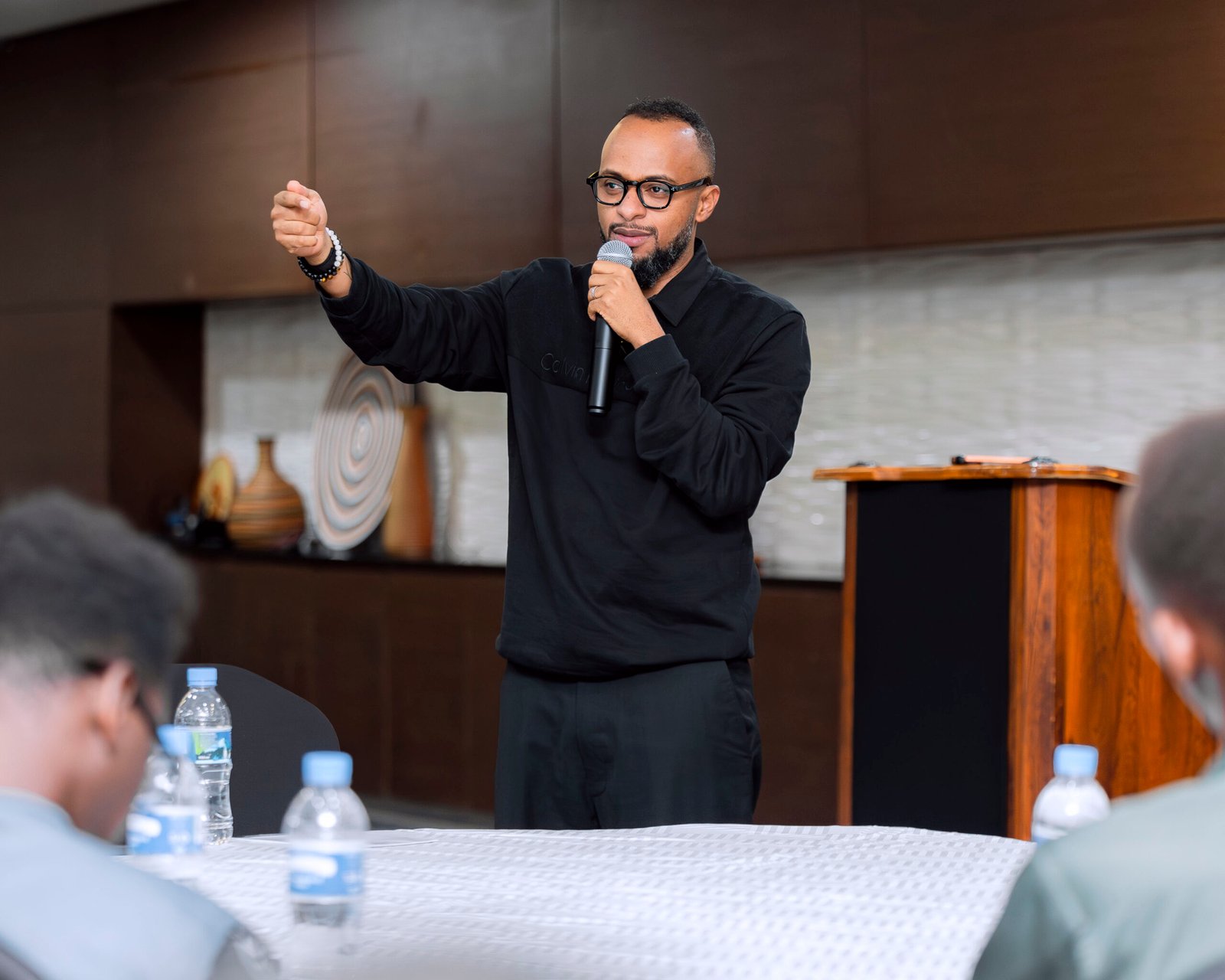
Building Belief: How Malik Shaffy Lizinde Is Shaping Africa’s Future Through Creativity, Culture, and Purpose
In the vibrant streets of Nyamirambo, one of Kigali’s most culturally diverse and energetic neighborhoods, life unfolds with a rhythm all its own. Football matches spill onto dusty roads; music drifts through the air; small businesses bustle with activity, and conversations flow across languages, cultures, and generations. It is a place where creativity is not a profession. It is a way of life.
For Malik Shaffy Lizinde, these streets were more than the backdrop of his childhood. They were his first classroom.
Long before he became a respected entrepreneur, creative strategist, educator, and changemaker, Malik was learning valuable lessons about resilience, community, and innovation simply by observing the people around him. He watched traders turn modest opportunities into thriving businesses. He saw families persevere through challenges with determination and optimism. He witnessed how culture, storytelling, and human connection could bring people together and create meaningful change.
“Nyamirambo is not just a neighborhood,” he says. “It is a culture. It is movement, people creating, debating, surviving, and finding a way. It teaches you very early that life will not always wait for you to be ready.”
Those early experiences would eventually shape a leadership philosophy that continues to guide his work today, a belief that creativity is far more than artistic expression. It is a powerful force for solving problems, creating opportunities, and helping people believe in a better future.
Today, Malik stands among a new generation of African leaders who are redefining entrepreneurship through purpose, innovation, and social impact. As the Founder of 63 INC, a leading creative and behavioral communication agency, and through his work across education, youth empowerment, and social development initiatives, he has built a reputation for turning ideas into platforms that create lasting value for communities.
Yet, at the heart of his journey lies a simple conviction: leadership is not about building personal success. It is about creating opportunities for others to thrive.
The Foundation of Hope
Malik often reflects on the influences that shaped his perspective on leadership and life. Among them, none has been more significant than his family.
His mother, in particular, instilled in him a belief that continues to guide him through challenges and opportunities alike.
“She taught me that hope is not a weakness,” he says. “Hope is strength. It is the decision to believe that something better can still be built.”
That lesson carried special significance in a country that has experienced one of the most remarkable transformations in modern history.
Growing up in Rwanda, Malik belongs to a generation that witnessed a nation rebuilding itself after the 1994 Genocide against the Tutsi. The country’s journey from tragedy to progress left a lasting impression on him. It demonstrated that resilience, vision, and collective effort can transform even the most difficult circumstances into opportunities for renewal and growth.
For Malik, Rwanda’s story is ultimately a lesson in leadership. It shows that true leaders do more than manage organizations. They help people believe in possibilities. They create trust, inspire confidence, and turn hope into action.
This understanding has become a guiding principle throughout his career.
Turning Creativity into a Catalyst for Change
When Malik and his brother Khalilu founded 63 INC, they shared a vision that challenged traditional thinking about communication.
They believed that communication could be more than advertising campaigns, visual design, or corporate messaging. It could become a tool for business growth, social impact, behavior change, and cultural expression.
At a time when many organizations focused heavily on appearances, Malik saw an opportunity to create something deeper.
“People do not only respond to beauty,” he explains. “They respond to the truth. They respond to something that feels close to their lives.”
This insight became the foundation of 63 INC’s approach.
Rather than beginning with messages, the agency begins with people. It seeks to understand their experiences, motivations, aspirations, and realities before attempting to influence behavior or shape perceptions.
The result has been an agency that combines strategic thinking with empathy, creating campaigns and initiatives that resonate because they reflect genuine human experiences.
Today, 63 INC works across branding, behavioral communication, content creation, events, strategy, and social impact campaigns. Its clients include major institutions, development partners, and leading brands throughout Rwanda and beyond.
For Malik, however, the agency represents something larger than commercial success.
It is proof that African creativity can compete on a global stage while remaining deeply connected to local culture and community.
“Empathy is a strategy. Culture is intelligence. Storytelling is leadership,” he says.
Those words have become a defining philosophy not only for 63 INC but for Malik’s broader vision of leadership and transformation.
Building Platforms That Matter
While many entrepreneurs focus on building businesses, Malik focuses on building platforms.
Across every stage of his career, a common thread connects to his work: creating opportunities that empower others.
One of the clearest examples of this commitment is Kina Rwanda, a social enterprise dedicated to promoting early childhood development through play-based learning.
Under his leadership, the initiative has reached more than one million children across Rwanda, helping parents, teachers, and communities better understand the importance of play in a child’s development.
For Malik, this achievement goes far beyond numbers.
Each child represents a future waiting to be shaped. Each parent who embraces play-based learning gains a new perspective on education. Each moment of curiosity and imagination becomes an investment in the next generation.
“Children are not numbers,” he says. “When I think about reaching over a million children, I think about a child laughing as they learn. I think about a teacher seeing a child becoming more confident. I think about the small moments that never make it into reports but stay in people’s hearts.”
His dedication to youth empowerment extends even further.
Through initiatives such as Ni Nyampinga and Tujibebe, Malik helped create platforms that amplified the voices of young people, particularly girls and underserved communities.
One achievement he remains especially proud of was helping build one of Rwanda’s largest magazine distribution networks, ensuring that content reached young girls in some of the country’s most remote communities.
That experience reinforced a belief he continues to carry today: young people do not need others to speak for them. They need opportunities, trust, and access.
Leadership Beyond the Individual
As his ventures expanded, Malik faced a challenge familiar to many entrepreneurs.
In the early years, he was deeply involved in every aspect of work, developing ideas, managing relationships, solving problems, and driving execution.
While this approach helped build momentum, it also revealed an important leadership lesson.
“If everything depends on you, then you have not built an organization,” he says. “You have built pressure around yourself.”
Learning to trust others, delegate responsibility, and create systems became one of the most significant turning points in his leadership journey.
Today, his approach is guided by four principles: clarity, trust, humanity, and accountability.
He believes teams perform best when they understand not only what they are doing but why it matters. He encourages creativity while maintaining high standards. Most importantly, he strives to see people as individuals rather than simply employees.
“People are not machines,” he says. “They come to work with dreams, family pressure, ambition, pain, and hope. A leader must see the person, not only the output.”
This balance between empathy and excellence has enabled him to build teams that are both creative and disciplined, capable of delivering meaningful work while remaining connected to a larger purpose.
Imagining Africa’s Future
Looking ahead, Malik is optimistic about Africa’s future.
He believes the continent’s next chapter will be shaped by individuals who can successfully connect creativity, technology, and purpose.
Artificial intelligence, digital platforms, and emerging technologies will continue transforming industries. At the same time, Africa’s creative economy, from design and media to storytelling, fashion, gaming, and content creation, will become an increasingly important driver of economic growth and cultural influence.
Yet amid rapid technological change, Malik believes one factor will become even more valuable: trust.
People will increasingly gravitate toward leaders, brands, and institutions that communicate authentically, act consistently, and remain connected to the communities they serve.
“The future will belong to builders who are culturally rooted, digitally fluent, and brave enough to imagine differently,” he says.
It is a vision that reflects both his entrepreneurial mindset and his deep commitment to social impact.
A Legacy of Opportunity
When asked about his proudest accomplishments, Malik does not point to awards, titles, or personal recognition.
Instead, he speaks about opportunities.
The young creative who discovers confidence in their talent.
The child who learns through play.
The entrepreneur who strengthens a business and creates jobs.
The student who gains the courage to pursue a dream.
These are the achievements that matter most to him because they extend beyond individual success and create lasting impact for others.
As one of Africa’s most transformational leaders to watch in 2026, Malik Shaffy Lizinde represents a new model of leadership, one that combines creativity with discipline, ambition with humility, and innovation with purpose.
His story is a reminder that meaningful change does not begin with resources alone. It begins with belief: belief in people, belief in possibilities, and belief that a better future can be built.
And perhaps that is the legacy he hopes to leave behind, not simply successful businesses or influential campaigns, but a generation of people empowered to create, lead, and believe in their own potential.
As he puts it, “Success is good, but success that opens doors for others is better.”